






Related Posts
Online Message
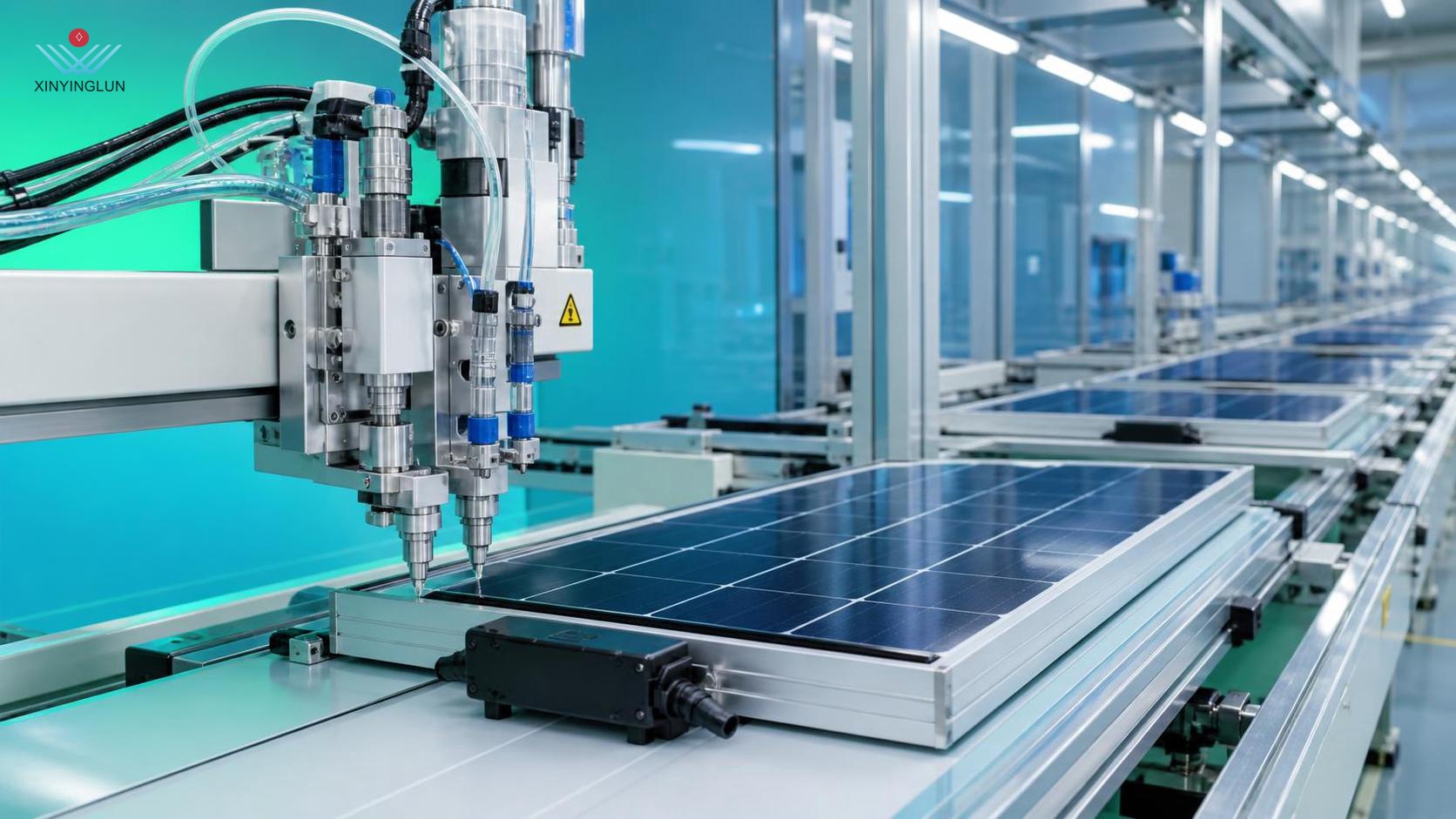
Why Two-Component Dispensing Matters in PV Module Production
In photovoltaic module manufacturing, adhesive application is rarely a minor finishing step. The materials used around frames, junction boxes, edge seals, and selected structural bonding points can influence mechanical stability, moisture resistance, electrical safety, appearance, and the repeatability of the final assembly process. That is the practical context behind searches for XINYINGLUN two component dispensing equipment: manufacturers are usually trying to determine whether a two-part dispensing system is appropriate for a specific bonding or sealing task, and what conditions must be controlled before it can deliver a reliable result.
Two-component dispensing equipment is designed to meter, mix, and apply materials supplied in two separate parts, commonly identified as resin and hardener, base and curing agent, or Part A and Part B. These materials only develop their intended curing and performance characteristics when mixed within the required ratio and processed under suitable conditions. In a manual or semi-manual setup, ratio errors, incomplete mixing, inconsistent bead geometry, and variable working time can all become production risks. Automated dispensing aims to reduce those sources of variation.
For PV manufacturers, the value is not simply that a machine can dispense adhesive faster. The more important question is whether it can keep adhesive performance stable across shifts, batches, operators, module formats, and production volumes.
The Main Applications Are Bonding, Sealing, and Process Consistency
A two-component system is generally used where a one-part adhesive does not offer the required balance of cure speed, bonding strength, gap-filling ability, environmental resistance, or process control. In photovoltaic module assembly, the exact application depends on module design, materials, adhesive chemistry, and plant process layout. Common use cases may include frame bonding and sealing, junction box attachment, edge-related sealing operations, and other controlled structural or protective adhesive applications.
For example, an aluminum frame must be bonded to a laminated module in a manner that supports consistent placement and adequate adhesion without creating excessive squeeze-out or contaminating visible surfaces. The adhesive bead must be positioned correctly, applied at a stable volume, and remain workable long enough for the framing operation. If the bead is discontinuous, too thin, too thick, poorly mixed, or applied outside the intended path, the result may be lower bond reliability, cosmetic defects, downstream rework, or uncertainty during quality inspection.
Junction box-related applications can be equally sensitive. Adhesives and sealants in this area may contribute to fixing, sealing, or protecting an assembly that must remain dependable through temperature cycling, humidity exposure, vibration, handling, and field operation. The dispensing system does not replace engineering validation of the adhesive or junction box design. It does, however, determine whether a validated process can be reproduced at production scale.
This distinction matters. A high-quality adhesive cannot compensate for inaccurate metering or poor mixing. Conversely, a precise dispensing machine cannot turn an unsuitable adhesive formulation into a durable PV assembly. The equipment, material, module design, and quality-control plan need to be considered as one process system.
What the Equipment Actually Controls
A XINYINGLUN two-component dispensing solution, like other industrial two-part dispensing systems used in module automation, is intended to bring control to several linked stages: material feeding, ratio metering, mixing, bead application, motion coordination, and process traceability. The details vary by configuration, but buyers should understand what each stage means in operational terms.
- Material feeding: The system must handle the adhesive packaging format and viscosity range used by the plant. Drum, pail, cartridge, or bulk-feed arrangements may require different pumping and transfer designs.
- Ratio metering: Part A and Part B must be delivered in the adhesive supplier’s specified proportion. A small deviation can affect cure behavior, hardness, bond development, or long-term environmental performance.
- Mixing: The system may use static or dynamic mixing depending on material behavior and process requirements. The goal is homogeneity before application, not simply combining two streams of material.
- Dispensing path and volume: Motion control, valve response, nozzle design, and program settings affect bead location, cross-section, continuity, start-stop quality, and corner behavior.
- Timing: Pot life, open time, assembly time, and curing sequence must match the actual line rhythm. A stable bead is not enough if the module cannot be assembled within the material’s allowed working window.
- Monitoring: Pressure, flow, ratio, temperature, alarms, and production records can help identify deviations before they become a larger batch-quality problem.
In practice, manufacturers should not treat “automatic dispensing” as a single capability. The relevant capability is stable dispensing of a particular material, at a specified ratio, into a defined module design, under a known takt time and acceptable quality standard.
Where Automation Delivers the Strongest Business Value
The strongest case for a two-component dispensing system is usually found in repetitive, high-volume processes where adhesive quality has a direct effect on product reliability or rework cost. A production line that relies on skilled operators to manually mix and apply a two-part material may work at low volume, during development, or for specialized products. But as throughput increases, process variation becomes more expensive and harder to diagnose.
Automation can improve consistency in several ways. Metering removes some of the uncertainty associated with manual proportioning. Programmed paths make bead placement more repeatable. Controlled dispensing pressure and valve actions can reduce variation at the beginning and end of a bead. Integration with conveyors, framing stations, vision systems, or manufacturing execution systems can reduce waiting time and manual handoffs.
Material use is another important factor. Adhesives are often evaluated primarily by unit price, but actual material cost depends on consumption, waste, purge volume, rejected parts, and rework. A system that applies a more controlled bead may reduce unnecessary over-application. However, this benefit should be measured rather than assumed. Some material systems require regular flushing, mixer replacement, purging, or controlled startup procedures, all of which affect real consumption.
For a plant producing multiple module sizes, automation can also help with changeover discipline. Recipes can define path dimensions, output volume, speed, and timing for different products. That said, recipe management only works when it is supported by permission controls, verification procedures, and clear engineering ownership. A stored program does not guarantee that the correct program was selected or that a change has been properly validated.
Two-Component Equipment Is Not Automatically the Right Choice
It is easy to assume that two-component dispensing is inherently more advanced than one-component application. That is not a useful purchasing rule. The appropriate choice depends on the adhesive chemistry and the production objective.
One-component materials may be preferred where moisture curing, heat curing, UV curing, or other single-part mechanisms fit the process and where simplicity in storage, feeding, and maintenance is valuable. Two-component materials are often chosen when curing must be less dependent on ambient moisture, when thicker bond lines or enclosed areas need predictable cure, when rapid handling strength is needed, or when a particular chemical and mechanical performance profile is required. These are material and process decisions first, equipment decisions second.
A two-component platform adds operational requirements. The plant needs disciplined material storage, temperature control where required, ratio verification, nozzle and mixer maintenance, cleaning procedures, trained operators, and a defined response to alarms. If production volume is low, product designs change frequently, or adhesive use is intermittent, the operational overhead may outweigh the expected benefits.
There is also a common misunderstanding around “zero waste” claims. Two-component systems can reduce over-dispensing and manual mixing losses, but they do not eliminate material loss. Purge cycles, line priming, mixed-material disposal, cleaning, and maintenance consumables must be included in the cost model. Buyers should ask suppliers to clarify what material loss is expected during startup, changeover, shutdown, and normal operation for the intended adhesive.
What to Evaluate Before Selecting a System
Equipment selection should start with a process specification, not a general request for a dispensing machine. The first document should define the module or component, the adhesive type, material supplier guidance, target bead geometry, production rate, operating shifts, acceptable defect criteria, and line-integration boundaries. Without this information, a supplier can demonstrate a machine, but it is difficult to confirm that the proposed configuration will perform reliably in the buyer’s actual environment.
The adhesive itself is central. Ask whether the equipment has been tested with the intended formulation or with materials of comparable viscosity, filler content, mix ratio, and sensitivity to temperature. Filled adhesives can behave very differently from low-viscosity materials. Abrasive fillers may affect wear components. Moisture-sensitive materials may require dry-air handling or sealed transfer arrangements. Materials that settle during storage may need agitation or circulation. These issues should be reviewed with both the adhesive supplier and the equipment supplier.
Buyers should also examine the dispensing head and mixing arrangement. Static mixers can be practical and consistent for many applications, but they may create disposable consumable costs and generate mixed-material waste at shutdown. Dynamic mixing may suit other chemistries or flow requirements, but it can introduce cleaning and maintenance considerations. There is no universal best solution; the decision should reflect material behavior, expected duty cycle, cleanup strategy, and quality requirements.
For automated PV lines, integration deserves the same attention as the dispenser itself. The system may need to communicate with upstream and downstream stations, receive product recipes, confirm workpiece presence, handle product positioning tolerances, and provide fault signals to the line controller. A dispensing cell that performs well in a standalone demonstration can still cause line losses if its loading, unloading, curing, or fault-recovery logic is poorly matched to the broader production flow.
Service capability should be evaluated early, especially for overseas installations. Questions worth asking include whether local or remote technical support is available, which spare parts should be stocked on site, how long critical replacements take to deliver, what preventive-maintenance tasks are expected, and whether production personnel can diagnose common faults without waiting for a field engineer. In high-throughput module plants, a dispensing station can become a bottleneck if routine maintenance was not built into the operating model.
Quality Control Must Go Beyond Visual Inspection
A neat-looking adhesive bead is useful, but visual appearance alone is not sufficient evidence of process quality. A bead may look continuous while the mix ratio is incorrect, the internal mixture is incomplete, the adhesion surface is contaminated, or the cure profile is unsuitable. PV manufacturers should connect dispensing control to a broader validation plan.
Depending on the application, this may include incoming material checks, ratio verification, bead width and height measurement, mass or volume checks, adhesion testing, cure confirmation, cross-section examination, pull or shear tests, and environmental reliability testing. The appropriate test methods and acceptance criteria should be established by the manufacturer’s engineering and quality teams, with reference to product design requirements and applicable standards. Specific standards, certification requirements, and test thresholds should be confirmed for the intended market and module configuration.
Traceability is particularly valuable when a problem emerges after shipment. Recording batch identification, dispensing recipe, key process parameters, alarm events, operator actions, and production time can narrow the scope of investigation. It can also help a plant distinguish between a material issue, an equipment issue, a surface-preparation issue, and an assembly-timing issue. Without usable records, teams may spend days debating causes that could have been identified through basic process data.
Questions That Expose the Real Capability of a Supplier Proposal
When reviewing a proposal for XINYINGLUN two component dispensing equipment or a comparable system, procurement teams should avoid relying only on nominal output claims. The more revealing questions are practical ones:
- Can the supplier run the buyer’s actual adhesive, substrates, and part geometry during acceptance testing?
- How is the mixing ratio measured, calibrated, and monitored during production?
- What happens when pressure, flow, temperature, or ratio moves outside the allowed range?
- How are corners, bead starts, stops, overlaps, and interruptions controlled?
- What is the expected changeover time between module models or adhesive batches?
- Which parts are consumable, which are wear items, and what maintenance intervals are recommended?
- How much material is typically consumed by priming, purging, cleaning, and mixer replacement?
- Can the system provide parameter records that support the plant’s quality and traceability requirements?
- What line-side space, utilities, ventilation, temperature conditions, and safety provisions are required?
These questions shift the discussion from machine features to process ownership. That is where the return on investment is decided.
The Decision Is About Repeatability, Not Just Dispensing
For solar manufacturers, two-component dispensing equipment is most useful when adhesive application is a meaningful reliability and throughput variable rather than a simple manual task. It can support controlled bonding and sealing, reduce avoidable variation, and make a validated adhesive process easier to reproduce at scale. But the equipment should be evaluated as part of a complete manufacturing system that includes material qualification, module design, operator practice, maintenance, integration, and quality assurance.
The right next step is usually a process trial using representative materials and production parts, followed by a clear acceptance plan. A supplier demonstration should prove more than bead appearance: it should show stable ratio control, repeatable application, manageable maintenance, appropriate cycle time, and data that can be used when quality questions arise. In PV manufacturing, that level of evidence is more valuable than a broad claim of automation.
Please give us a message