






Related Posts
Online Message
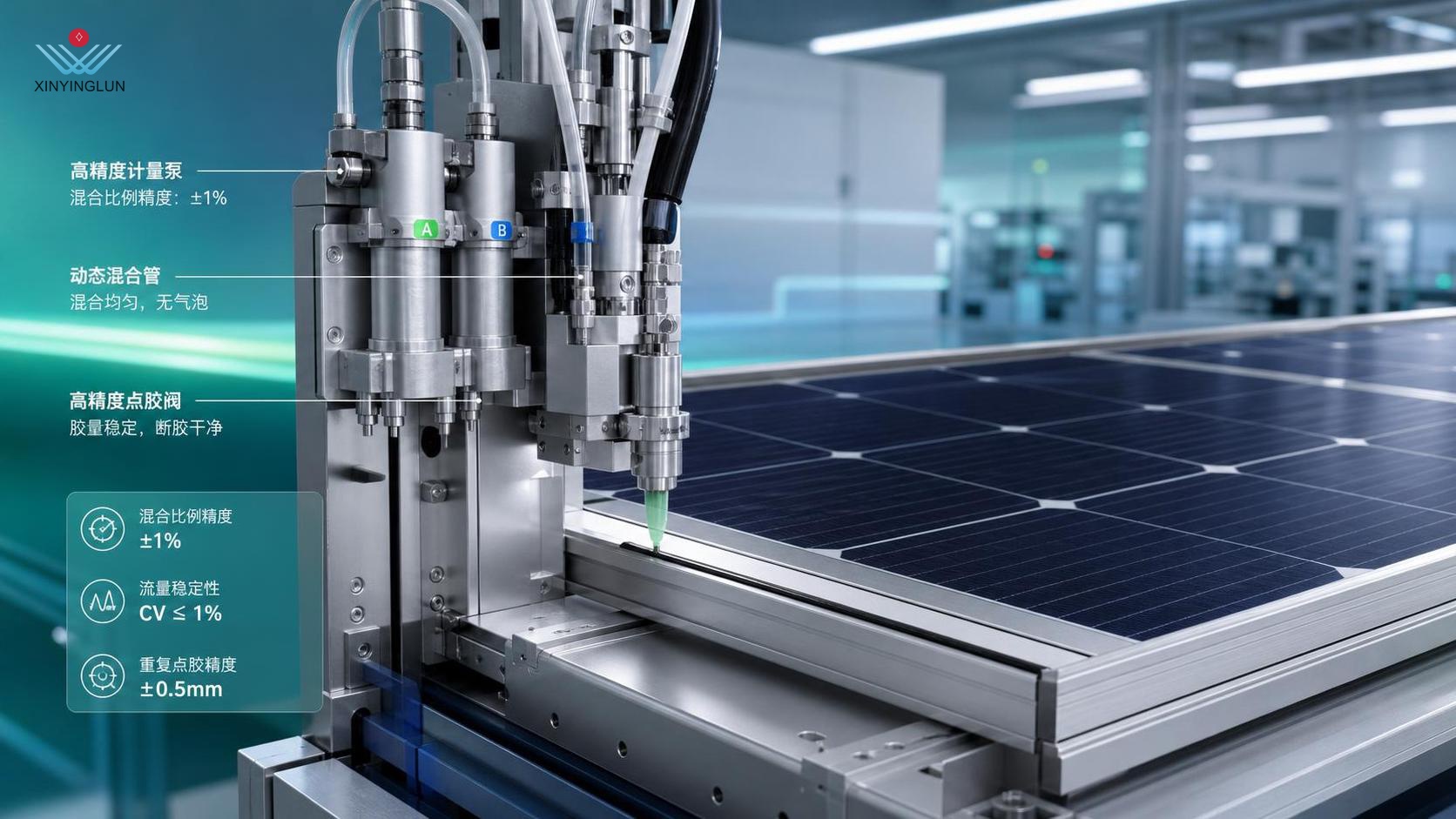
It usually starts with a small production problem that refuses to stay small. A bead line looks slightly narrower at one end, the cured material feels inconsistent from batch to batch, or a downstream inspection step keeps raising questions that do not point to a single obvious fault. In new energy manufacturing, especially where sealing, potting, bonding, or encapsulation must stay stable over long runs, these issues often lead people back to the same question: when choosing a two component dispensing machine, which parameters actually matter most?
This question matters because the wrong focus can waste a lot of evaluation time. Many teams first compare output speed, tank volume, or catalog-level automation features. Those items are visible and easy to discuss, but they do not always explain whether the process will remain stable once material A and material B begin interacting in real production conditions. If your job is technical assessment, the better approach is to judge the machine by the parameters that control proportioning, mixing behavior, material delivery, and process compatibility under realistic operating conditions.
Why speed is rarely the first parameter to lock in
A common mistake is to treat dispensing speed as the primary indicator of capability. Speed matters, of course, but in two-component processes, a fast machine that cannot hold a stable ratio or maintain uniform mixing is more likely to create hidden defects than a slightly slower machine with tighter process control.
For photovoltaic and related new energy applications, the dispensed material is often doing more than just filling a gap. It may support insulation, environmental sealing, thermal management, structural bonding, or long-term durability under outdoor exposure. In those cases, a visually acceptable bead does not prove the chemistry was processed correctly. The machine must deliver the two materials in the intended proportion and mix them consistently enough that the cured result behaves as expected.
That is why the first screening step should move away from headline throughput and toward process stability. When people later discover bubbles, cure variation, poor adhesion, or inconsistent edge quality, the root cause often comes from one of a few parameters that should have been examined earlier.
The parameter that usually decides everything else: mixing ratio accuracy
If one parameter deserves top priority, it is mixing ratio accuracy. A two-component material only performs properly when resin and hardener, or base and catalyst, are delivered in the correct proportion. Even a machine with precise motion control can fail the process if ratio control drifts during startup, during continuous production, or when viscosity changes with temperature.
When assessing ratio accuracy, it helps to ask more specific questions than “Is the ratio adjustable?” Adjustment range alone is not enough. The more useful concerns are whether the ratio remains stable over time, whether the control method is volumetric or mass-based, how the machine compensates for pressure fluctuation, and how easily the operator can verify the actual delivered ratio rather than the set value on the screen.
In practice, ratio performance should be reviewed under several conditions: low flow, normal flow, restart after pause, and longer continuous operation. Some machines appear acceptable during a short test but drift once the material warms up, the pump cycles repeatedly, or line pressure changes. That kind of drift may not be obvious at the nozzle, yet it can show up later as poor cure consistency.
Repeatability matters more than one good sample
During evaluations, it is easy to be impressed by a single clean demo. The harder question is whether the machine can repeat the same dispensing result every cycle, every shift, and after maintenance or material refill. Repeatability includes shot size consistency, bead geometry consistency, start-stop behavior, and return to stable output after interruptions.
For a technical review, this is where process thinking becomes important. If the machine is intended for edge sealing, junction box bonding, frame-related adhesive application, or encapsulant dispensing, the acceptable window is usually defined by downstream requirements, not by appearance alone. A machine that sometimes over-delivers at the start of a path and under-delivers near the end may still look “good enough” to the naked eye, but it introduces variation that accumulates across modules and increases inspection burden.
Repeatability also depends on mechanical details: pump design, servo response, valve behavior, hose layout, and pressure stabilization. Even when the metering principle is sound, poor coordination between material feed and motion path can create inconsistent deposition. This is why evaluation should include repeated cycles rather than a one-time proof of concept.
Flow stability is where many hidden problems begin
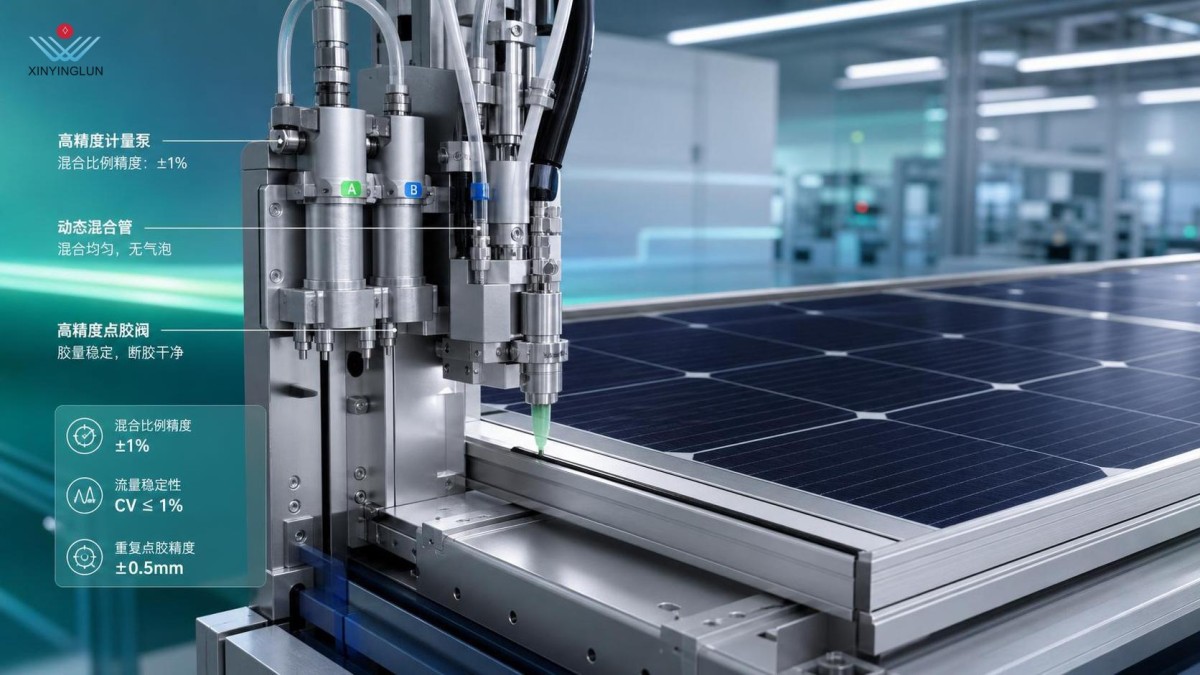
Flow stability sounds similar to repeatability, but it deserves separate attention. A machine may repeat total volume reasonably well while still showing pulsation, intermittent surging, or unstable discharge at the nozzle. In a two component dispensing machine, unstable flow can disturb the mix pattern, create entrapped air, or leave uneven distribution within the bead.
For higher-viscosity materials, this becomes even more sensitive. Material compressibility in hoses, pump pulsation, and pressure recovery after valve opening can all influence flow behavior. If the machine runs at multiple speeds or path geometries, assess whether the flow remains smooth during acceleration, deceleration, corners, and pause-resume conditions. That is often where real process weaknesses appear.
Temperature control also belongs here. In many new energy production environments, material viscosity shifts with ambient or storage conditions. If the machine relies on stable viscosity but does not actively manage or compensate for temperature-related changes, then a parameter that looked acceptable in the morning may not hold by the afternoon. Stable flow is not just about pump capacity; it is about the whole material path staying controlled.
Mixing quality is not guaranteed by ratio alone
Even with perfect proportioning, the final material can still perform poorly if mixing is incomplete. This is another area where assessors sometimes rely too heavily on nominal specifications. Static mixers, dynamic mixers, mixing chamber design, residence time, and flushing behavior all influence whether the two components become uniformly combined before deposition.
The right evaluation question is not simply “Does it mix?” but “Does it mix adequately for this specific material and this specific process window?” Some materials tolerate a wider mixing window, while others react quickly or have a narrow viscosity balance that makes incomplete blending more likely. If the application involves electrical insulation, weather sealing, or structural attachment, inconsistent mixing can create failures that only appear later in testing or field use.
One practical way to think about mixing quality is to connect it to the process path. If material is dispensed in long continuous beads, corner transitions, narrow tracks, or varying section thicknesses, the machine should maintain consistent mixing without producing dead zones, unmixed streaks, or excessive pressure buildup. Ease of mixer replacement and cleaning also matters, because a machine that becomes difficult to maintain will often lose stability in actual production even if it performed well during initial trials.
Pot life, curing behavior, and downtime tolerance
Another parameter that deserves early attention is compatibility with the material’s pot life and curing profile. A technically capable machine can still be a poor fit if the mixed material begins reacting too quickly for the line rhythm, or if purge and restart behavior wastes excessive material after short stoppages.
Technical assessors should look at how the machine handles pauses, cleaning cycles, and restart after downtime. Does it allow predictable recovery? Can the system purge mixed material efficiently before curing causes obstruction? Does the process require dynamic mixing because the material reacts too fast in a static path? These are not secondary questions. They strongly influence uptime, maintenance frequency, and the practical difficulty of running the process day after day.
This is especially relevant in facilities where dispensing is only one step in a larger automation sequence. The machine must fit the real takt pattern, not an ideal uninterrupted cycle. If upstream handling delays or downstream inspection interruptions are likely, then the dispensing system should be judged on its tolerance for those interruptions.
Integration with motion control and factory automation
In many assessments, integration is left until late in the decision process. That can create problems. A dispensing unit may look strong as a standalone device but become difficult to coordinate once it is connected to conveyors, robots, vision systems, curing stages, or traceability software.
The more useful way to review integration is to ask whether process parameters can be synchronized with movement and whether alarms are meaningful enough for troubleshooting. For example, ratio deviation, pressure abnormality, temperature drift, and material shortage should not only be detectable; they should be presented in a way that helps operators and engineers identify the source quickly.
Recipe management is another parameter worth checking carefully. If the production line handles more than one module format, adhesive path, or material type, recipe switching must preserve the intended ratio, path speed, and dispensing logic without creating unnecessary setup risk. A machine with weak parameter management often becomes dependent on operator memory, which increases variability.
Material compatibility is more than a catalog statement
Suppliers often state that a machine supports low, medium, or high viscosity materials, but that description is too broad for a technical decision. Material compatibility should be reviewed in terms of actual rheology, filler content, abrasiveness, sensitivity to moisture, degassing tendency, and required storage conditions. A two component dispensing machine that performs well with one epoxy may behave very differently with a filled silicone or polyurethane.
This is why bench testing should be tied to the real material family and expected operating environment. If the process is connected to broader photovoltaic manufacturing or end-of-life panel handling workflows, equipment selection may also need to consider adjacent automation stages. In some production and recycling discussions, people end up reviewing not only dispensing quality but also how related equipment fits the line. For example, in workflows involving panel recovery or material separation, it can be practical to compare supporting equipment such as Devitrification machine for waste photovoltaic panels when planning a more complete process chain, even though it serves a different step. The point is not to combine unrelated functions, but to evaluate equipment choices in the context of the whole operation rather than as isolated purchases.
Where evaluators often misread maintenance requirements
Maintenance is easy to underestimate because it does not always appear in initial performance tests. Yet for two-component systems, maintenance affects dispensing quality directly. Wear in pumps, seals, valves, and mixers can alter ratio stability and flow behavior long before a complete failure occurs.
Instead of asking whether maintenance is “easy,” ask what components require regular replacement, how calibration is verified after service, whether contamination risk exists during refill, and how cleaning procedures affect restart time. If a machine needs frequent manual intervention in material-contact parts, that should be treated as a process parameter, not merely a service issue.
A useful sign during evaluation is whether the machine allows straightforward confirmation after maintenance. If technicians cannot quickly verify ratio, flow consistency, and pressure status after servicing, then every intervention creates uncertainty. Over time, that uncertainty becomes a production risk.
A more reliable way to compare machines during technical assessment
When several machines appear similar on paper, comparison becomes clearer if you center the review on a few process questions. Can the system keep the intended ratio stable across realistic operating conditions? Can it deliver smooth, repeatable flow through the required path geometry? Does the mixing method match the material’s reaction behavior? Can the machine recover predictably after pauses, cleaning, and routine maintenance? And can it integrate cleanly into the line without hiding critical alarms or forcing unstable manual adjustments?
These questions usually separate equipment that is merely functional from equipment that is genuinely suitable for precision manufacturing. They also help avoid a common problem in procurement discussions: choosing based on visible hardware features while leaving the harder process variables unresolved.
In some cases, the right machine will not be the one with the highest nominal throughput or the most complex interface. It will be the one that holds ratio, mixing, flow, and restart behavior within the process window your line actually needs. That sounds less dramatic than comparing speed or size, but in new energy production it is often the difference between a stable dispensing process and one that keeps generating “small” quality issues that never really disappear.
If you are evaluating a two component dispensing machine, the most important parameters are the ones that protect material behavior from variation: ratio accuracy, repeatability, flow stability, mixing quality, curing compatibility, automation coordination, and maintenance recoverability. Once those are confirmed, throughput and convenience features become much easier to judge in a meaningful way. Without them, the machine may still dispense material, but it may not support the consistency that technical assessment is supposed to protect.
Please give us a message